At the summit of Lantau Peak in the centre of Lantau Island, there is a sequence of up to 120 m of fine ash tuff and rhyolite. This sequence differs geochemically from the underlying Lantau Volcanic Group in several respects and most notably in its low TiO2-content (So, 2000). In this respect it resembles the Kau Sai Chau Volcanic Group in general. High precision U–Pb zircon age-dating of a fine ash tuff near the base of this sequence has returned an age of 141.1 ± 0.2 Ma (GEO, unpublished data), which is within error of other dates from the Kau Sai Chau Volcanic Group (see below). This, in addition to the geochemical similarities, indicates that the outlier should be correlated with the Kau Sai Chau Volcanic Group, but as yet it cannot be assigned to a specific formation. Therefore, the outlier unconformably overlies the Lantau Volcanic Group.
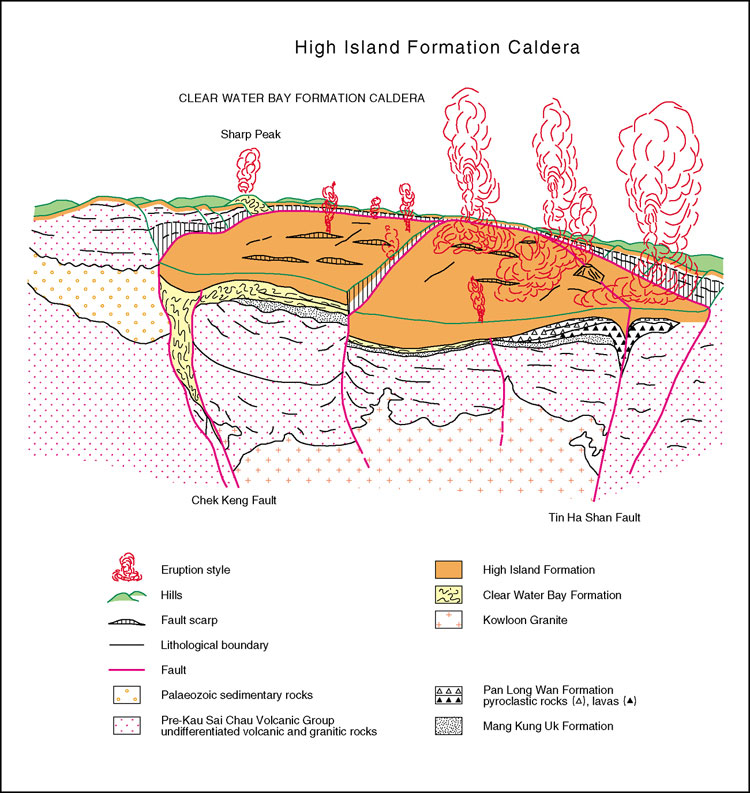
A narrow, east-striking outcrop of volcanic rocks that have been assigned to the Kau Sai Chau Volcanic Group (undifferentiated) lies within the Tin Ha Shan Fault towards the southern end of the Clear Water Bay Peninsula. The outcrop probably contains representatives of both the Clear Water Bay and High Island formations. The fault may have been a conduit used during the emplacement of both formations (Figure 5.28).
Details
Clear Water Bay Peninsula. Detailed mapping of the southern Clear Water Bay Peninsula, in the vicinity of Tai Miu Wan and the Clear Water Bay Golf Club, suggests that fine ash vitric tuff infills an east-west trending topographic hollow. The formation is well exposed along the coast immediately west of the Tin Hau Temple (847800 814600 Kku-1), where the characteristic fine ash vitric tuff contains abundant small tabular feldspar crystal and some quartz crystals, set in an almost glassy matrix. Small fiamme are occasionally present, as are small angular aphanitic clasts. The rock is characteristically uniform throughout the coastal section, but is cut by several quartz monzonite and mafic dykes, and east-west striking fissure vents. 400 m northwest of the temple (847770 814970 Kku-2), on the northern edge of the outcrop, the fine ash tuff is seen lying with marked unconformity against the eutaxite of the Che Kwu Shan Formation, with the contact surface dipping 60o to the south. On the west side of Tai Miu Wan (847110 814570 Kku-3) the formation lies with steep unconformity on flow-banded trachydacite of the Pan Long Wan Formation. Abundant small-scale fiamme are seen on the slightly weathered surfaces along the shoreline of Jam Pan Wan (849200 814350 Kku-4). Again, tuff lies with marked unconformity on underlying trachydacite lava.